 University of Michigan School of Public Health
 Arizona State University, Barrett, the Honors College
Recurrence risk assessment for treated breast cancer patients
XGBoost · SMOTE · Calibration · R Shiny
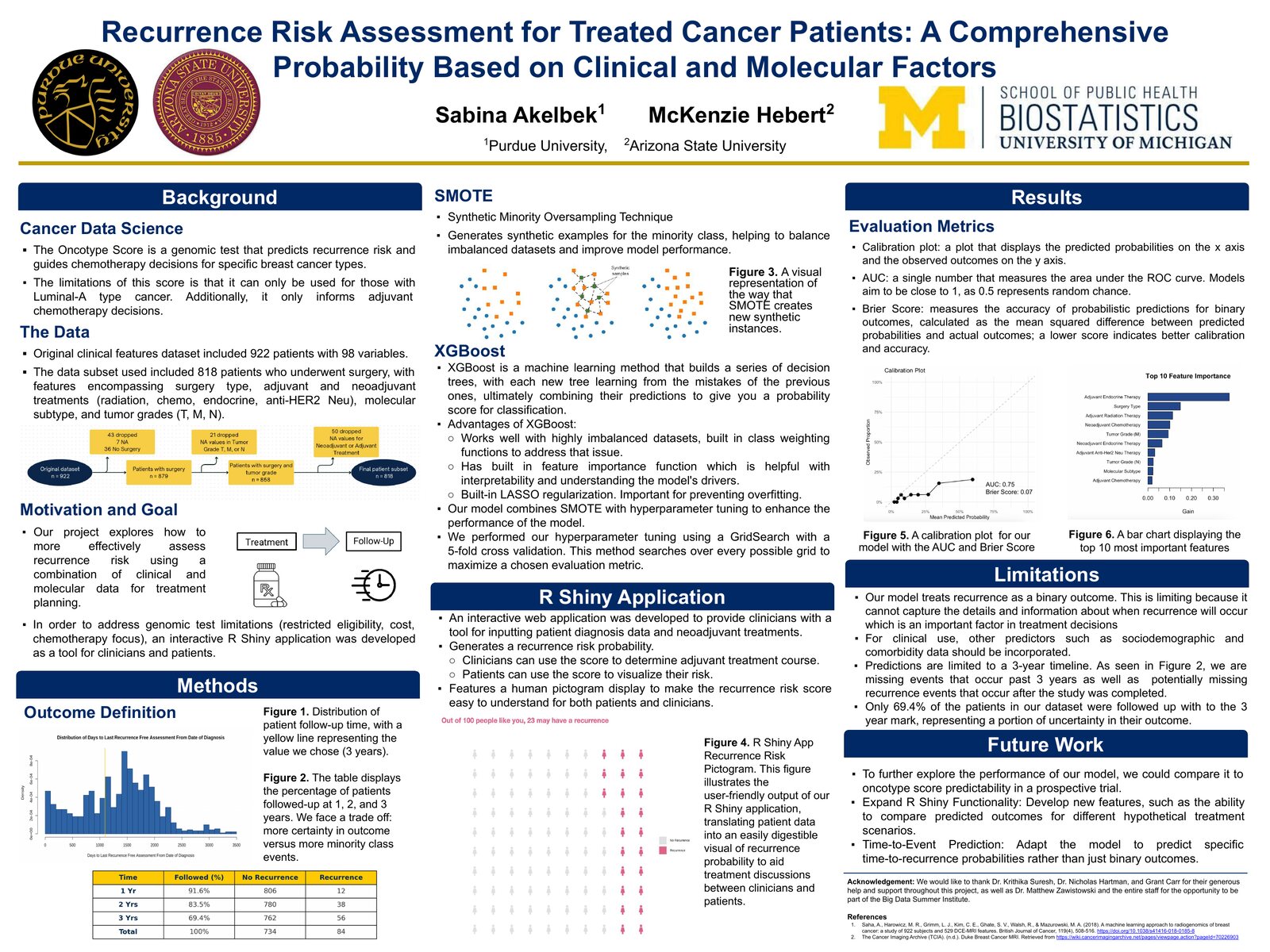
The Oncotype score predicts recurrence risk for only some breast cancer types and informs only chemotherapy decisions. This project built a model on a broader set of clinical and molecular factors, then put it in an R Shiny app that clinicians and patients can read.
922patients in source data
818in the modeling cohort
98variables
0.75AUC
0.07Brier score
Cohort
922Original dataset
879Underwent surgery
858Tumor grade recorded
818Treatment data complete
Follow-up and events
| Window | Followed | Recurrences |
|---|---|---|
| 1 year | 91.6% | 12 |
| 2 years | 83.5% | 38 |
| 3 years | 69.4% | 56 |
What the app shows a patient
Out of 100 people like you, 23 may have a recurrence
Approach
- Defined recurrence as a binary outcome within 3 years of diagnosis.
- Balanced the minority class with SMOTE and tuned XGBoost by grid search with 5-fold cross validation.
- Chose the Brier score as the primary metric to judge calibration of predicted probabilities, with AUC alongside.
- Built and deployed the R Shiny app that takes diagnosis and treatment inputs and returns a risk probability.
Limitations and next steps
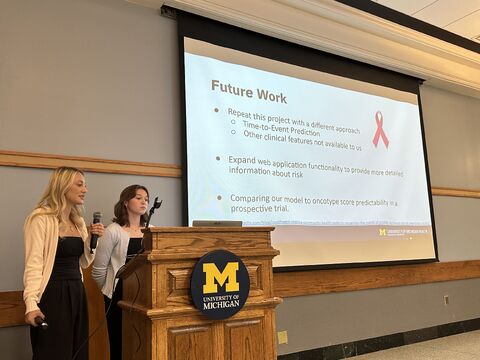
- A binary outcome drops timing. Next step is time-to-event prediction.
- Only 69.4% of patients were followed to the 3-year mark.
- Sociodemographic and comorbidity predictors would be needed for clinical use.
- Compare against Oncotype score predictions in a prospective trial.